
Medicare Supplement in Florida 2026: What Plan G Changes Mean for You
Medicare Supplement in Florida 2026: What Plan G Changes Mean for You

If you are approaching 65 or already on Medicare in the Sunshine State, the Medicare Supplement in Florida 2026 landscape is going to look very different from what you see today. In particular, Plan G – currently the most popular choice for new Medigap buyers – will sit at the center of higher premiums, new Part B and Part D rules, and tighter household budgets. This article is a deep, plain-English report on what Medicare Supplement in Florida 2026 means for you if you either already have Plan G or you are thinking about enrolling in it.
Our goal is not to scare you, but to give you the kind of detailed, practical information that real people use to make good decisions. We will break down how Medigap works, why Plan G became the “default” choice after Plan F closed to new enrollees, how national and Florida-specific changes will influence your wallet in 2026, and the smart steps you can take now to protect yourself.
If at any point you prefer one-on-one help instead of reading a long report, you can visit our Medicare Supplement page for Florida residents here:
Medicare Supplement Plans in Florida.
1. A Quick Refresher: What Is a Medicare Supplement Plan in Florida?
Before we focus on Plan G and the detailed Medicare Supplement in Florida 2026 environment, let’s refresh how Medigap works. Original Medicare (Part A and Part B) was never designed to pay 100% of your health costs. There are deductibles, copayments and coinsurance amounts that you must pay yourself. A Medicare Supplement plan – also called Medigap – is a policy sold by private insurance companies to cover some or all of those “gaps” left by Original Medicare.
These plans are standardized at the federal level. That means a Plan G from one carrier must cover the same core benefits as a Plan G from another carrier. The premium, underwriting rules and service experience can change from company to company, but the benefits are defined by federal law. Florida follows this same standardized structure.
In plain terms: Medigap helps you budget. Instead of wondering “How big will the bill be?” every time you see a doctor or go to the hospital, you pay a predictable monthly premium and the plan picks up most of the extra costs that Medicare leaves behind.
Remember, Medigap is different from Medicare Advantage (HMO or PPO). With Medigap, you keep Original Medicare, can see any provider who accepts Medicare, and your Supplement helps pay the leftovers. With Medicare Advantage, you join a private network that replaces Original Medicare for your day-to-day coverage. This Medicare Supplement in Florida 2026 report focuses on Medigap, not Advantage, although we will compare them when it helps you see the bigger picture.
2. Why Plan G Became the Star of Medicare Supplement in Florida 2026
Until a few years ago, Plan F was the “gold standard” because it covered everything that Medicare didn’t, including the Part B deductible. But federal law changed the rules: people who became newly eligible for Medicare on or after January 1, 2020, can no longer enroll in Plan F or Plan C. Because of that, Plan G stepped into the spotlight.
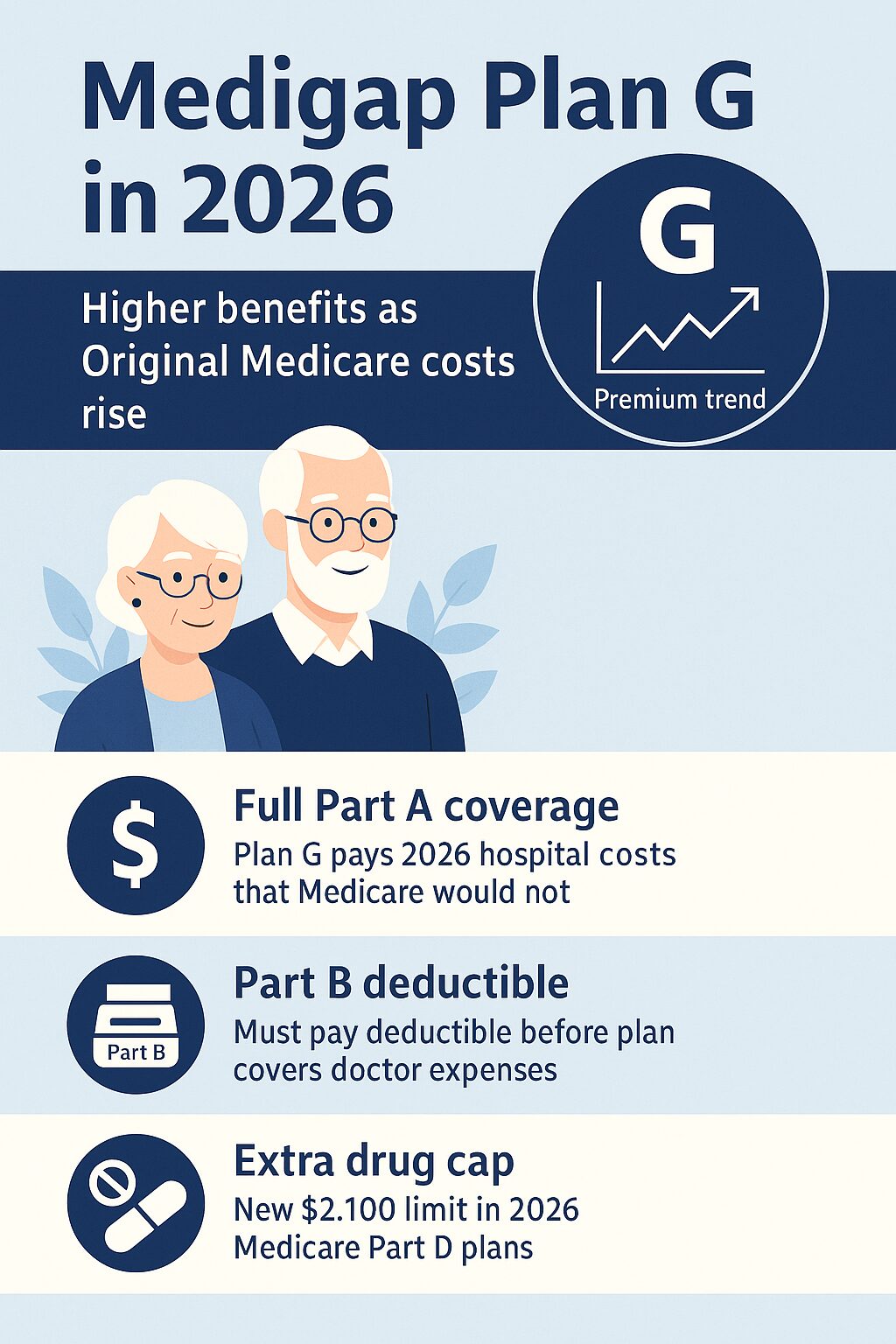
In most states – and increasingly in Florida – new Medigap buyers choose Plan G because it mirrors Plan F in almost every way. The one big difference is that Plan G does not pay the Part B deductible. You pay that deductible once per year out of pocket; after that, Plan G usually covers the rest of your Part A and Part B coinsurance and copays for the rest of the year.
For many people, this trade-off makes sense. They pay a lower premium compared with Plan F (when it is still available to older enrollees), they accept one small deductible, and then they enjoy very predictable costs the rest of the year. That is why so many national analyses show that Plan G has become one of the most popular Medigap options in the country, and why the Medicare Supplement in Florida 2026 market revolves around it.
There is also a high-deductible Plan G version available in some states. With that version, you pay a larger annual deductible before the plan begins to pay; in exchange, the monthly premium is lower. If you are healthy and mainly worried about catastrophic bills, high-deductible Plan G sometimes looks attractive – but in 2026 that deductible will be near the three-thousand-dollar mark, so you must be very intentional before choosing it.
3. The Bigger Picture: What Changes Are Coming to Medicare in 2026?
To understand the Medicare Supplement in Florida 2026 story, you have to look beyond just Plan G and consider the broader Medicare environment. Several big changes are already scheduled or proposed for 2026:
- Part B premiums and deductibles are rising. National projections show the standard Part B premium and the Part B deductible both increasing in 2026, partly due to higher health care costs and more people entering Medicare.
- Part D prescription drug benefits are being reshaped. Under the Inflation Reduction Act, out-of-pocket costs for prescription drugs will be capped at just over two thousand dollars in 2026. There will also be ongoing drug price negotiations that affect some of the most commonly used medications.
- Standalone drug plans are shrinking in number. Many insurers are consolidating or leaving the Part D market, meaning fewer plan choices but also stronger pressure to compare formularies and pharmacy networks carefully.
All these changes affect how valuable your Medicare Supplement in Florida 2026 coverage will feel. Even though Medigap benefits themselves do not normally change from year to year, the underlying Medicare costs – and the overall health-care ecosystem – do change. And that is exactly where Plan G comes in.
4. How Medicare Supplement in Florida 2026 Interacts With Plan G Coverage
One of the most important things to understand is that a Medicare Supplement in Florida 2026 plan is layered on top of Original Medicare. That means whatever happens to hospital deductibles, doctor coinsurance, or skilled nursing copays automatically flows through to your Supplement.
For Plan G, this usually works in your favor. After you pay the Part B deductible once per year, Plan G typically covers:
- The full Part A hospital deductible
- Hospital coinsurance and additional lifetime reserve days
- Part B coinsurance for doctor visits and outpatient care
- Skilled nursing facility coinsurance
- Part A hospice coinsurance
- Emergency care when traveling outside the U.S. (up to plan limits)
So when Part A or Part B costs rise in 2026, the Plan G benefits become even more valuable. The key question for Floridians is not whether Plan G still works – it does – but how the Medicare Supplement in Florida 2026 pricing will adjust. That is where premiums, underwriting and carrier competition come into play.
5. Premium Pressures on Medicare Supplement in Florida 2026
Premiums for Medicare Supplement plans in Florida depend on several factors: your age, your ZIP code, whether the policy uses attained-age or issue-age pricing, tobacco use, and in some cases gender or household discounts. Insurers also look at claim experience across their entire Florida block of business.
As health-care costs rise and more people use their coverage, insurers experience higher claim expenses. That eventually shows up as premium increases. Analysts expect that 2026 will be a year of above-average premium pressure, for three reasons:
- Higher utilization. Many people postponed elective procedures during the pandemic and are catching up now, especially older adults with chronic conditions.
- Rising provider prices. Hospitals and physician groups are renegotiating reimbursement rates to keep up with inflation and staffing challenges.
- Drug cost changes. While Part D caps are designed to protect you, insurers must adjust their pricing as responsibility for catastrophic coverage shifts between the government, carriers and manufacturers.
The result is that most experts expect the average Medicare Supplement in Florida 2026 premium for Plan G to be higher than in 2025, and for some carriers the increase may be substantial. That is why it is so important not only to “have” Plan G, but to have it with the right company at the right price for your age band and ZIP code.
If you already have Plan G and have not reviewed your premium for a few years, 2026 is an ideal time to compare options. In many cases, you can keep the same Plan G benefits and simply move to another carrier with a lower rate, subject to underwriting.
6. Florida-Specific Realities: Why Medicare Supplement in Florida 2026 Is Unique
Florida is not a typical Medicare state. More than half of Medicare beneficiaries in Florida choose Medicare Advantage, while hundreds of thousands still rely on Medigap for freedom of choice and predictable out-of-pocket costs. The Medicare Supplement in Florida 2026 market has unique characteristics:
- High concentration of older retirees. Florida attracts retirees from across the country, many of whom prefer Medigap so they can see any Medicare provider and travel without network rules.
- Regional premium differences. Premiums for Plan G can look very different between South Florida, Central Florida and the Panhandle due to provider pricing and claim patterns.
- Heavy competition between carriers. Because Florida is a large market, many national and regional insurers compete for Medigap business, which creates opportunities to shop but also more complexity.
All these factors mean that you cannot simply copy what a friend in another state is doing. You need a Medicare Supplement in Florida 2026 strategy built around Florida’s demographics, Florida’s carriers and Florida’s pricing trends.
If you also have an ACA plan or a spouse under 65 on Marketplace coverage, be sure to review our ACA content as well:
ACA Plans in Florida.
Coordinating ACA and Medicare correctly can save a family thousands of dollars over several years.
7. Plan G vs Other Medigap Plans in the 2026 Florida Market
To understand the real value of Medicare Supplement in Florida 2026 options, you need to see Plan G in context. Other common Medigap plans include:
- Plan N – Lower premiums than G, but you pay small copays for doctor visits and emergency room, and you may face Part B excess charges in some states.
- High-deductible Plan G – Much lower premium, but you must pay a large deductible before full coverage kicks in.
- Legacy Plan F – Closed to new enrollees but still held by many older beneficiaries; covers the Part B deductible, but often with higher premiums and potentially sharper rate increases over time.
When you compare these options, Plan G often emerges as the “sweet spot.” You take on one modest Part B deductible, but you get nearly full coverage for Part A and Part B gaps. In 2026, as Part A and Part B costs rise, that trade-off becomes even more attractive, which is why the Medicare Supplement in Florida 2026 discussion so often comes back to Plan G.
However, Plan N can still make sense for people who are comfortable with copays and who rarely visit specialists, while high-deductible Plan G may be appropriate for certain healthy, higher-income individuals who mainly want catastrophic protection.
8. How Part D Changes Interact With Your Medicare Supplement in Florida 2026 Strategy
Medigap does not include prescription drug coverage. You still need a standalone Part D plan or a creditable alternative. The 2026 Part D changes – especially the new hard cap on out-of-pocket costs – are good news for many retirees, but they also change how you evaluate your overall costs.
Under the new rules, once your total prescription spending reaches the national cap, you stop paying for covered drugs for the rest of the year. That gives you more certainty. However, insurers can still adjust premiums, deductibles and formularies within that framework. That means your Medicare Supplement in Florida 2026 evaluation needs to consider:
- Your Plan G premium
- The Part B premium and deductible
- Your Part D premium and deductible
- Your typical monthly drug costs and likelihood of reaching the cap
For many people, the combination of Plan G plus a carefully chosen Part D plan will remain the most flexible and predictable way to handle major medical and drug costs, especially in Florida where provider choice is important.
9. Underwriting and Enrollment Windows for Medicare Supplement in Florida 2026
One of the most misunderstood parts of Medigap is underwriting. When you first enroll in Part B at 65, you have a one-time six-month open enrollment window in which you can buy any Medigap plan available in your area without medical underwriting. After that window closes, companies in Florida can ask health questions, review your medical history and even decline your application, unless you qualify for a special guaranteed-issue situation.
That is why the decisions you make around age 65 are so important. If you want Plan G and you are turning 65 in late 2025 or during 2026, you may only have one chance to lock in the best Medicare Supplement in Florida 2026 rate without medical questions.
If you already have a Medicare Supplement plan and want to switch companies in 2026 to get a better rate on Plan G, underwriting may apply. Some people will be accepted; others may be declined or offered a higher premium. Working with a knowledgeable agent who understands Florida’s underwriting practices is crucial.
10. Medicare Supplement in Florida 2026 vs Medicare Advantage in 2026
Many Floridians also ask the obvious question: “Should I stay with Medigap Plan G, or should I switch to a Medicare Advantage plan in 2026?” The answer depends on your health, budget, tolerance for networks, and preferences for referrals and authorizations.
Medicare Advantage plans often advertise low or even $0 premiums, but you must use their network of doctors and hospitals, and you pay copays and coinsurance as you go. There is an annual out-of-pocket maximum, but that maximum can be several thousand dollars per year. By contrast, a Medicare Supplement in Florida 2026 Plan G setup usually has a higher fixed monthly premium but much lower and more predictable out-of-pocket costs when you actually get care.
For people who travel, split time between Florida and another state, or see many specialists, Plan G is often worth the extra premium because it lets you use any provider that accepts Medicare nationwide. For people with very tight monthly budgets and fewer provider relationships, an Advantage plan might seem appealing – but it is critical to compare the total cost for YOUR expected health-care usage.
If you are unsure which direction to go, a good strategy is to build two “what-if” budgets – one with Medicare Advantage, and one with Medigap plus Part D – and then compare not just the average costs, but also the worst-case scenarios.
11. Building a Smart Medicare Supplement in Florida 2026 Plan G Strategy
At this point, we have covered the big pieces: how Medigap works, why Plan G is central, what is changing in Medicare, and why Florida is unique. Now let’s turn these facts into a concrete strategy you can use. A solid Medicare Supplement in Florida 2026 strategy includes the following steps:
Step 1 – Get a Clear Picture of Your Health and Budget
List your chronic conditions, your regular doctors, the medications you take, and your typical health-care usage. Then set two numbers:
- How much you can comfortably afford per month for premiums.
- How much risk you can tolerate in a bad year if something serious happens.
Step 2 – Compare Plan G Against Plan N and High-Deductible G
Use your numbers to compare each option. For many people, standard Plan G still strikes the right balance between monthly cost and protection. For others, Plan N or high-deductible G might be viable alternatives if they understand the trade-offs.
Step 3 – Look at Multiple Carriers
Because Medigap benefits are standardized, the real differences are price, underwriting rules, rate-increase history and customer service. A strong Medicare Supplement in Florida 2026 strategy always compares multiple companies before enrolling.
Step 4 – Coordinate With Your Part D or Other Coverage
Make sure your Part D plan (or retiree coverage) works well with your Medigap plan. If you have a spouse who is not yet on Medicare and still uses ACA or employer coverage, coordinate those timelines carefully. Our ACA Florida page is a good companion resource:
ACA Plans in Florida.
Step 5 – Review Annually, Even if You Stay Put
Even if you love your Plan G, it is wise to review your premiums and coverage each year. Sometimes a newer carrier enters the market with better rates for your age band. Other times, your health status changes, and what made sense two years ago is no longer the best fit.
12. How We Help With Medicare Supplement in Florida 2026 Decisions
Sorting through all these numbers and rules alone can feel overwhelming. That is exactly why we specialize in guiding Florida residents through the Medicare Supplement in Florida 2026 decision process. When we work with you, we:
- Review your current coverage, including any Medicare Advantage or employer plans.
- Explain Plan G, Plan N and other Medigap options in simple language.
- Compare rates from multiple carriers in your specific Florida ZIP code.
- Help you understand underwriting questions and what to expect.
- Coordinate your Medigap choice with your Part D or other coverage.
Our job is not just to “sell a policy,” but to build a Medicare strategy that makes sense for your health, your family and your retirement goals. In many cases, that means choosing Plan G; in others, it might mean a different plan or even staying with an existing option and simply adjusting Part D.
If you are also thinking about how your Medicare choices connect with your long-term retirement income or tax planning, you may want to explore how certain life insurance policies can create tax-advantaged supplemental income. We discuss those strategies here:
Life Insurance and Retirement Analysis.
13. Final Thoughts: What Plan G Changes Really Mean for You
When you step back from all the numbers, the message of this Medicare Supplement in Florida 2026 report is simple: Plan G is still a powerful tool for protecting your health and your savings, but the environment around it is changing. Premiums are likely to rise, Medicare rules for drugs and cost-sharing are shifting, and Florida’s demographics make planning more important than ever.
The good news is that you are not powerless. By understanding how Plan G works, what to expect in 2026, and how to compare your options intelligently, you can keep control of your coverage instead of letting the system control you.
If you are turning 65 soon, already have a Medigap plan, or feel that your current coverage does not fit your life anymore, now is the time to review your situation. We are here to walk with you, step by step, in English or Spanish, with patience and clarity.
To schedule a personal review of your Medicare Supplement in Florida 2026 options, you can reach us here:
All Insurance Community – Contact Page.
You do not have to face these changes alone. With the right information and guidance
Key Takeaways
- Medicare Supplement in Florida 2026 will see changes, especially for Plan G, impacting premiums and benefits.
- Plan G has grown popular as it covers most Medicare gaps, excluding the Part B deductible.
- Significant Medicare changes in 2026 include rising Part B costs, restructuring Part D benefits, and fewer standalone plans.
- Premium increases for Medigap policies are likely due to higher healthcare utilization and costs.
- Floridians must tailor their Medicare Supplement strategies to the unique characteristics of the state market.
Frequently Asked Questions About Medicare Supplement Plan G in Florida
Is Medicare Supplement Plan G still worth it in Florida in 2026?
Yes. Medicare Supplement Plan G remains one of the most reliable choices for Florida seniors in 2026 because it offers predictable out-of-pocket costs and nationwide access to Medicare providers.
Can I switch Medicare Supplement plans in Florida?
In many cases, yes. Florida residents may be able to switch Medicare Supplement plans, including Plan G, but medical underwriting may apply depending on health conditions and timing.
Does Plan G cover the Medicare Part B deductible?
No. Medicare Supplement Plan G does not cover the Medicare Part B deductible. Once the deductible is paid, Plan G typically covers most remaining Medicare-approved costs.
Is Medicare Supplement better than Medicare Advantage in Florida?
It depends on individual needs. Medicare Supplement plans offer broader provider choice and more predictable costs, while Medicare Advantage plans may have lower premiums but network restrictions.